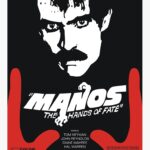
 There are movies that fail because they don’t have enough money, movies that fail because they don’t have enough talent, and then there is Manos: The Hands of Fate, a 1966 horror film that somehow managed to turn almost every possible filmmaking limitation into part of its enduring charm.
Directed by and starring Harold P. Warren, Manos was made on an extremely small budget after Warren reportedly took up a challenge that he could make a horror movie despite having no previous filmmaking experience. What followed was a production plagued by technical problems, awkward performances, bizarre editing, and a story that moves at a pace that can generously be described as leisurely.
Yet decades later, Manos is still being watched.
Not because it’s scary.
Not because it’s particularly well made.
But because it is one of the most fascinatingly terrible movies ever released.
A Vacation Takes a Wrong Turn
The story begins with Michael, Margaret and their young daughter Debbie traveling through rural Texas.
They’re looking for a place to stay and eventually encounter a strange lodge.
The man who runs the property is Torgo, an extremely unusual caretaker who immediately makes it clear that something isn’t quite right.
Torgo is played by John Reynolds, whose performance has become one of the movie’s most famous features.
He walks strangely.
He talks strangely.
He gestures strangely.
Almost everything about him is strange.
And yet he is also the closest thing the movie has to a memorable character.
The family decides to stay at the lodge despite Torgo’s warnings.
This turns out to be a poor decision.
Enter the Master
The lodge belongs to a mysterious figure known as the Master.
He is played by Tom Neyman and spends much of the movie sitting in a chair, looking ominous.
The Master has a collection of wives who are expected to follow his bizarre rules.
Eventually, Michael and Margaret realize that they have wandered into a cult.
The basic premise is actually perfectly reasonable for a horror movie.
A family gets stranded at an isolated lodge controlled by a mysterious cult leader.
That’s a solid setup.
The problem is everything that happens between those moments.
The World’s Slowest Horror Movie
Manos is famous for its pacing.
The movie takes an extraordinarily long time to get anywhere.
There are extended driving sequences.
Long conversations.
Long pauses.
Characters walking around.
Characters looking at things.
Characters talking about things that don’t seem especially important.
The movie often feels as though it is waiting for something to happen.
Then, eventually, something does.
And then it waits again.
This pacing would be disastrous in most movies.
In Manos, it becomes part of the entertainment.
Watching the film becomes an exercise in anticipation.
You begin wondering when the next genuinely bizarre scene will arrive.
The Technical Problems
The movie’s technical limitations are obvious.
The cinematography is rough.
The editing is awkward.
The sound is inconsistent.
The acting ranges from stiff to completely surreal.
The special effects are minimal.
The production frequently looks more like a home movie than a theatrical horror film.
There is also the famous issue with the camera.
Warren reportedly used a camera that required a significant amount of time to reset between shots, making editing difficult.
The result is a movie filled with strange transitions and awkward cuts.
Instead of hiding the limitations, the film displays them proudly.
Torgo Steals the Movie
The undisputed star of Manos is Torgo.
His enormous legs, strange walk and unusual speech patterns have made him one of the most recognizable characters in cult-movie history.
John Reynolds’ performance is so unusual that it almost feels like he is performing in a completely different movie.
Torgo claims to be the Master’s servant.
He also has an unexplained connection to the lodge and its inhabitants.
The character’s bizarre physicality makes every scene involving him unpredictable.
He doesn’t simply enter a room.
He appears.
He doesn’t simply speak.
He delivers every line with a strange rhythm that makes ordinary conversation sound bizarre.
Torgo is a major reason the movie remains watchable.
Without him, Manos would probably be considerably less entertaining.
The Master and His Wives
The Master’s relationship with his wives provides another strange subplot.
The women repeatedly argue about which one of them should remain with the Master.
Their discussions are presented with surprising seriousness.
The Master eventually decides that one wife must be sacrificed.
The movie then moves into increasingly bizarre territory involving the cult’s rituals and internal power struggles.
None of this is particularly frightening.
But it is undeniably strange.
And strange is exactly what Manos does best.
The Horror That Isn’t Very Scary
As a horror movie, Manos isn’t especially effective.
There are no sophisticated scares.
There is little suspense.
The atmosphere occasionally works, but the production limitations make it difficult to maintain tension.
Instead, the movie’s entertainment value comes from its incompetence.
That places it firmly in the “so bad it’s good” category.
It’s the kind of movie where viewers begin noticing filmmaking mistakes instead of becoming frightened by the story.
Once that happens, the experience changes.
You’re no longer watching to see whether the family survives.
You’re watching to see what happens next.
The MST3K Rescue
For many viewers, Manos might have disappeared completely if not for Mystery Science Theater 3000.
The television series featured the movie in an episode during the show’s later years, introducing it to a huge new audience.
The sarcastic commentary gave the movie a completely different life.
Scenes that had once been painfully slow became opportunities for jokes.
Awkward dialogue became punchlines.
Technical problems became entertainment.
Torgo became an icon.
The MST3K treatment essentially transformed Manos from an obscure failure into a cult classic.
That’s an extraordinary second act for any movie.
The Legacy of Manos
Today, Manos: The Hands of Fate is often cited alongside Plan 9 from Outer Space, Troll 2 and The Room as one of the great “so bad it’s good” movies.
But Manos has something particularly fascinating about it.
You can feel how badly everyone involved wanted to make a real horror movie.
The movie isn’t trying to be funny.
It isn’t a parody.
It isn’t intentionally absurd.
It is completely sincere.
That sincerity makes the mistakes even more entertaining.
The filmmakers were attempting something ambitious with almost no resources.
The result became something they never intended: one of the most memorable bad movies ever made.
Final Thoughts
Manos: The Hands of Fate is not a good movie.
That’s not an insult.
It’s the entire reason people remember it.
The pacing is painfully slow.
The acting is bizarre.
The editing is rough.
The story is strange.
The technical quality is poor.
The horror is minimal.
And yet the movie has personality.
Torgo alone makes it worth seeing.
The Master’s strange cult is unforgettable.
The awkward conversations are hilarious.
The long stretches of nothing happening become part of the experience.
And the fact that this strange little production eventually became a cult favorite through Mystery Science Theater 3000 is almost as entertaining as the movie itself.
Manos is proof that sometimes a movie doesn’t have to be good to be memorable.
It simply has to be weird enough.
And Manos: The Hands of Fate is very, very weird.
So-Bad-It’s-Good Rating: 9/10
Terrible filmmaking, unforgettable characters, painfully slow pacing, and an absolutely legendary cult-movie reputation.
Where to Stream
Can stream for free on Tubi (HERE)
This post has already been read 4 times!


