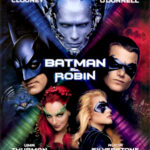
 There are superhero movies that become beloved classics, movies that become forgotten disappointments, and then there is Batman & Robin, a film so spectacularly committed to its own excess that it eventually became one of the most entertaining examples of Hollywood getting almost everything wrong.
Released in 1997 and directed by Joel Schumacher, Batman & Robin had everything a major superhero blockbuster could possibly want. It had Batman, Robin, Batgirl, Mr. Freeze, Poison Ivy, an enormous budget, major stars, elaborate sets, expensive costumes and an army of special-effects artists.
What it didn’t have was much restraint.
The result was a neon-colored, ice-pun-filled, completely ridiculous comic-book spectacle that has become legendary for all the wrong reasons.
And somehow, that’s exactly why it’s so much fun to watch.
George Clooney Becomes Batman
George Clooney took over the role of Batman from Val Kilmer, bringing a completely different personality to Bruce Wayne.
Clooney is charismatic and effortlessly cool, but Batman & Robin doesn’t really ask him to play Batman as a tortured crime fighter.
Instead, he’s essentially playing a very handsome guy wearing an absurdly complicated rubber suit.
The movie frequently treats Batman like a celebrity rather than a mysterious vigilante.
Even the famous Bat-suit gets the full 1990s treatment.
Yes, this is the movie with the Bat-nipples.
The costume design is so exaggerated that it immediately tells you what kind of movie you’re watching.
This isn’t Christopher Nolan’s Batman.
This is Batman as a giant action figure.
Robin Wants Respect
Chris O’Donnell returns as Dick Grayson, and Robin is much more important this time around.
Unfortunately, he’s also incredibly annoyed.
Robin wants to establish himself as an independent hero rather than simply being Batman’s sidekick.
Batman, naturally, doesn’t make that easy.
Their relationship becomes one of the movie’s central conflicts.
The problem is that their arguments are surrounded by motorcycles, neon lights, ridiculous villains and enough one-liners to fill several movies.
It all becomes wonderfully excessive.
Enter Mr. Freeze
Arnold Schwarzenegger plays Mr. Freeze, and he approaches the role with absolutely no interest in subtlety.
His character is obsessed with finding a cure for his frozen wife, but he also spends most of the movie making ice-related jokes.
Everything is a pun.
Everything.
“Cool party!”
“Chill out!”
“Let’s kick some ice!”
The movie has so many ice jokes that it eventually becomes an endurance test.
But Schwarzenegger’s commitment is admirable.
He delivers every ridiculous line as though it were the most important sentence ever spoken.
That’s part of the entertainment.
Poison Ivy Arrives
Uma Thurman plays Poison Ivy, and she appears to understand exactly what kind of movie she’s in.
Her performance is wildly theatrical.
She’s seductive, campy and completely over the top.
Ivy wants to take over the world and replace humanity with plants.
It’s a ridiculous plan.
But Thurman commits to it with enormous energy.
Her costumes are even more outrageous than the dialogue.
She essentially turns the movie into a live-action comic book.
Bane
Then there’s Bane.
Unfortunately, this version of Bane is very different from the intelligent, intimidating character audiences would eventually see in later Batman stories.
Here, Bane is basically a gigantic henchman.
He’s mostly there to smash things and grunt.
The character’s simplicity makes him almost fascinating.
The movie takes one of Batman’s most physically imposing villains and turns him into a human wrecking ball.
Gotham Becomes a Neon Wonderland
Perhaps the biggest star of Batman & Robin is Gotham City itself.
Joel Schumacher’s Gotham is enormous, colorful and completely unrealistic.
Everything glows.
Buildings have giant statues.
Cars look like futuristic toys.
The streets are filled with neon.
It doesn’t look like a real city.
It looks like the world’s most expensive comic-book set.
And honestly, that’s part of the movie’s appeal.
Schumacher wasn’t trying to create a realistic Batman universe.
He was creating a gigantic piece of pop art.
The problem is that the movie takes that visual style so far that eventually almost nothing feels serious.
The Bat-Credit Card
One of the most infamous moments comes when Batman produces a Bat-credit card.
It’s ridiculous.
It’s also a perfect representation of the movie.
Batman doesn’t just fight crime.
Apparently, he needs to pay for things.
The scene has become famous because it captures the movie’s complete lack of restraint.
Everything has to be bigger.
Everything has to be louder.
Everything has to be more commercial.
Why It’s So Much Fun
The strange thing about Batman & Robin is that its failures eventually become its strengths.
The dialogue is ridiculous.
The villains are absurd.
The costumes are insane.
The action is excessive.
The product-placement mentality is obvious.
The jokes are relentless.
And the movie never seems to realize how ridiculous it is.
That sincerity makes it incredibly entertaining.
You aren’t watching Batman & Robin because you expect a serious superhero drama.
You’re watching it because you want to see how much further it can possibly go.
And somehow, it always finds another level.
The Movie That Changed Batman
The film’s failure had enormous consequences.
After Batman & Robin, the Batman franchise went dormant for several years.
When Christopher Nolan eventually revived the character with Batman Begins, the approach was almost the exact opposite.
Gone were the neon colors.
Gone were the constant jokes.
Gone were the cartoonish villains.
The new films emphasized realism, atmosphere and psychological complexity.
In a strange way, Batman & Robin helped demonstrate what the next Batman movies needed to avoid.
Final Thoughts
Batman & Robin is not a good superhero movie.
It’s not even particularly close.
But as a “so bad it’s fun” experience, it’s magnificent.
George Clooney looks like he’s having fun.
Arnold Schwarzenegger turns every line into a theatrical event.
Uma Thurman goes completely over the top.
Chris O’Donnell spends the movie desperately trying to prove Robin matters.
Bane grunts.
Gotham glows.
Batman’s suit has nipples.
And somewhere in the middle of it all, someone hands Batman a credit card.
It’s ridiculous from beginning to end.
Yet there’s something strangely charming about its commitment to excess.
The movie never tries to be realistic.
It never tries to be understated.
It simply goes bigger, brighter and sillier until the whole thing becomes a spectacular piece of 1990s comic-book camp.
Maybe Batman & Robin isn’t the Batman movie anyone asked for.
But it’s the Batman movie that gave us ice puns, Bat-nipples and a Bat-credit card.
And nearly thirty years later, that’s pretty hard to forget.
So-Bad-It’s-Good Rating: 9/10
A neon-soaked, completely ridiculous superhero fever dream that is much more entertaining when you stop expecting it to be good.
This post has already been read 3 times!


