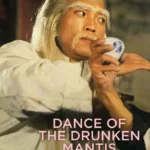
 Dance of the Drunken Mantis is one of those martial arts films that feels like a secret handshake among kung fu obsessives. Released in 1979 during the golden age of Hong Kong cinema, the movie sits at a fascinating crossroads between traditional kung fu storytelling and the increasingly acrobatic, comedic, and character-driven style that was exploding in the late 1970s. Directed by Yuen Woo-ping, one of the most influential action choreographers in film history, the movie is both a showcase of technical mastery and a quiet character study disguised as a crowd-pleasing kung fu flick.
At the center of the film is Beggar So, a legendary martial artist known for his drunken boxing style. Unlike the exaggerated, playful drunkenness popularized by Jackie Chan, this version of drunken kung fu is more deceptive and unsettling. Beggar So appears unstable, erratic, and even foolish, but every stumble hides intention. His movements lull opponents into a false sense of superiority before erupting into sudden, precise violence. The film treats this style not as a joke, but as a philosophy—one that values misdirection, patience, and psychological warfare.
Beggar So is portrayed by Yuen Siu-tien, whose real-life martial arts pedigree lends authenticity to every scene. His performance is remarkable in its restraint. He doesn’t mug for the camera or exaggerate his drunkenness for laughs. Instead, he embodies the archetype of the eccentric master, someone whose brilliance is hidden beneath layers of grime, unpredictability, and social marginalization. In many ways, Beggar So feels less like a character and more like a force of nature, drifting through the narrative on his own terms.
Opposite him is his son, Ah Cheung, played by Hwang Jang-lee, an actor more commonly cast as villains. Here, Hwang subverts expectations by portraying a disciplined but emotionally conflicted young man torn between resentment and admiration for his father. Ah Cheung’s journey provides the emotional backbone of the film. He begins ashamed of Beggar So’s public persona and skeptical of his unconventional teachings, longing instead for respectability and validation within more orthodox martial arts circles.
This father-son tension drives much of the story. Beggar So’s refusal to conform—to social norms, to martial arts orthodoxy, to parental expectations—creates a rift that feels deeply human. The film explores themes of generational misunderstanding, pride, and the painful process of recognizing value in what we once dismissed. Unlike many kung fu films where training montages are treated as necessary but routine, Dance of the Drunken Mantis makes instruction a battleground of ego and trust.
Yuen Woo-ping’s direction is subtle but confident. While the film features numerous fight scenes, it never feels rushed or bloated. Each confrontation serves a narrative purpose, either advancing the plot or deepening character relationships. Yuen’s choreography emphasizes clarity and rhythm, allowing viewers to appreciate the intricacies of mantis-style handwork blended with the off-balance footwork of drunken boxing.
The mantis style itself is beautifully showcased. Quick, snapping hand movements, intricate trapping techniques, and sudden changes in direction give the fights a distinct visual identity. When combined with drunken boxing’s feints and collapses, the result is a fighting style that feels alive—constantly shifting, reactive, and deeply tactical. It’s less about overpowering an opponent and more about unraveling them.
The film’s villains are understated but effective. Rather than relying on cartoonish evil, Dance of the Drunken Mantis presents antagonists who represent rigid thinking and cruelty disguised as discipline. Their martial arts prowess is formidable, but their lack of adaptability ultimately becomes their weakness. This contrast reinforces the film’s central argument: flexibility, both physical and emotional, is the true mark of mastery.
Visually, the movie is grounded and earthy. There’s little in the way of flashy cinematography or stylized lighting. Instead, the focus remains squarely on bodies in motion. The camera often holds back, allowing extended takes that showcase genuine skill rather than quick cuts. This approach gives the action a raw, tactile quality that modern fight choreography often lacks.
The tone of the film is also worth noting. While there are moments of humor—mostly stemming from Beggar So’s social interactions—they never undermine the story’s seriousness. The comedy is observational rather than slapstick, arising naturally from character rather than imposed gags. This restraint helps the film maintain a consistent mood, balancing entertainment with emotional weight.
As the story builds toward its climax, the emotional stakes and physical danger rise together. Ah Cheung’s eventual acceptance of his father’s teachings feels earned, not sentimental. The final confrontations are tense and satisfying, emphasizing strategy and endurance over sheer spectacle. Victory comes not from domination, but from understanding.
In the broader context of martial arts cinema, Dance of the Drunken Mantis stands as a bridge between eras. It honors traditional kung fu values—respect, patience, lineage—while embracing innovation and individuality. It lacks the pop-culture sheen of later drunken boxing films, but that restraint gives it a timeless quality.
The film’s influence can be felt in later works by Yuen Woo-ping and others who sought to blend character development with complex choreography. It may not be as immediately accessible as more comedic entries in the genre, but for viewers willing to engage with its subtleties, it offers rich rewards.
Today, Dance of the Drunken Mantis remains a compelling example of what kung fu cinema can achieve when action and story are treated as equal partners. It’s a film about reconciliation, adaptability, and the quiet wisdom that often hides behind unconventional appearances. In a genre filled with noise and bravado, its confidence lies in precision and patience.
This post has already been read 523 times!


