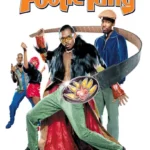
 Pootie Tang is one of those movies that feels less like a traditional comedy and more like a cultural prank that somehow escaped into theaters. Released in 2001 and written and directed by Louis C.K., the film arrived at a moment when studio comedies were getting slicker, safer, and more formulaic. Pootie Tang went the opposite direction. It doubled down on absurdity, leaned hard into nonsense, and trusted the audience either to come along for the ride or bail entirely. There was no middle ground then, and there really isn’t one now.
The premise, such as it is, revolves around Pootie Tang, a near-mythical folk hero who speaks in his own fractured, rhythmic language and dedicates his life to fighting evil in all its forms—corporate greed, domestic violence, tobacco companies, and general bad vibes. He doesn’t carry weapons, doesn’t wear a traditional costume, and doesn’t explain himself. He just shows up, delivers a barrage of unintelligible phrases, cracks someone with his belt, and disappears. In the world of the movie, this makes perfect sense.
Chris Rock plays Pootie with total commitment, which is essential to why the movie works at all. He never winks at the camera, never breaks character, and never tries to explain the joke. Pootie Tang is not ironic, and Rock understands that leaning into the sincerity of the character is what makes the nonsense land. Pootie is treated like a legend, someone whose presence alone inspires fear in villains and awe in the public, despite—or because of—his incomprehensible speech.
That speech is central to the film’s identity. Pootie’s dialogue is a mash-up of gibberish, rhythm, slang, and vocal percussion, delivered with the cadence of a funk song or a street-corner sermon. It’s nonsense, but it’s confident nonsense, and that confidence is the joke. Everyone around him understands exactly what he means, while the audience is left to piece together meaning through tone and context. It’s a bold choice that either clicks immediately or never does, and the film never slows down to help you adjust.
The story itself is deliberately skeletal. Pootie’s rise to fame is chronicled through exaggerated media coverage, toy merchandising, and a growing cult of personality. His nemesis, Dick Lecter, played with oily smugness by Lance Crouther, represents corporate exploitation and cultural appropriation, attempting to profit off Pootie’s image while stripping away its power. This sets up a loose satire of celebrity, capitalism, and the commodification of Black culture, though the movie is far more interested in jokes than lectures.
One of Pootie Tang’s greatest strengths is its supporting cast. Wanda Sykes is a standout as Biggie Shorty, Pootie’s manager and hype machine, delivering some of the film’s sharpest lines with perfect timing. Her exasperation with the world around her grounds the movie just enough to keep it from floating off into complete abstraction. J.B. Smoove also appears in an early role, adding another layer of comedic chaos to the mix.
The film’s aesthetic is deceptively simple. Shot like a low-budget superhero origin story, it mixes urban settings with heightened reality, where news reports feel like parody sketches and villains act like cartoon characters. There’s a deliberate cheapness to parts of the production that adds to the film’s charm, reinforcing the sense that this is a comic book brought to life by people who don’t care about polish as much as punchlines.
When Pootie Tang was released, it was largely misunderstood. Studio interference famously reshaped the final cut, trimming scenes and altering the pacing, which didn’t help its reception. Critics largely dismissed it as incoherent or juvenile, and audiences expecting a more traditional Chris Rock comedy were often baffled. The movie didn’t fail quietly—it failed loudly, becoming a punchline almost immediately.
But time has been kind to Pootie Tang. As comedy has evolved and audiences have grown more comfortable with anti-humor, surrealism, and deliberately abrasive styles, the film has found a second life. What once seemed random now feels intentional. What once felt sloppy now reads as anarchic. The movie’s refusal to explain itself or conform to expectations feels almost radical in hindsight.
There’s also something deeply specific about Pootie Tang’s sense of humor. It pulls from stand-up, sketch comedy, blaxploitation tropes, and hip-hop bravado, blending them into something that feels both rooted and untethered. It’s not trying to appeal to everyone, and that’s exactly why it resonates so strongly with the people who love it. The jokes aren’t designed to be universal; they’re designed to be confident.
At its core, the film is about power—who has it, who abuses it, and who refuses to play by the rules. Pootie doesn’t argue with villains, doesn’t negotiate, and doesn’t compromise. He simply exists as an unmovable force of righteousness, immune to corruption because he can’t be bought, understood, or controlled. That idea, wrapped in layers of silliness, gives the movie an odd kind of purity.
The ending of Pootie Tang doesn’t resolve much in a conventional sense, and it doesn’t need to. The point isn’t closure; it’s persistence. Pootie remains out there, fighting wrongs in his own strange way, unbothered by logic or criticism. That ethos mirrors the movie itself—a film that exists because its creators believed in it enough to let it be weird.
Watching Pootie Tang today feels like discovering a cult artifact that somehow slipped through the cracks of mainstream cinema. It’s not polished, not refined, and not interested in your approval. It dares you to either accept its rules or reject them outright. And in an era where so much comedy is designed to be instantly digestible, that stubbornness feels refreshing.
Love it or hate it, Pootie Tang is unforgettable. It’s a movie that shouldn’t work, doesn’t try to work, and somehow works anyway. Its legacy isn’t box office numbers or critical praise—it’s the fact that, decades later, people are still quoting it, defending it, and discovering it for the first time. That kind of staying power doesn’t come from playing it safe. It comes from swinging hard, speaking nonsense with conviction, and trusting that the right audience will understand.
Stream For Free On Tubi
This post has already been read 230 times!


