
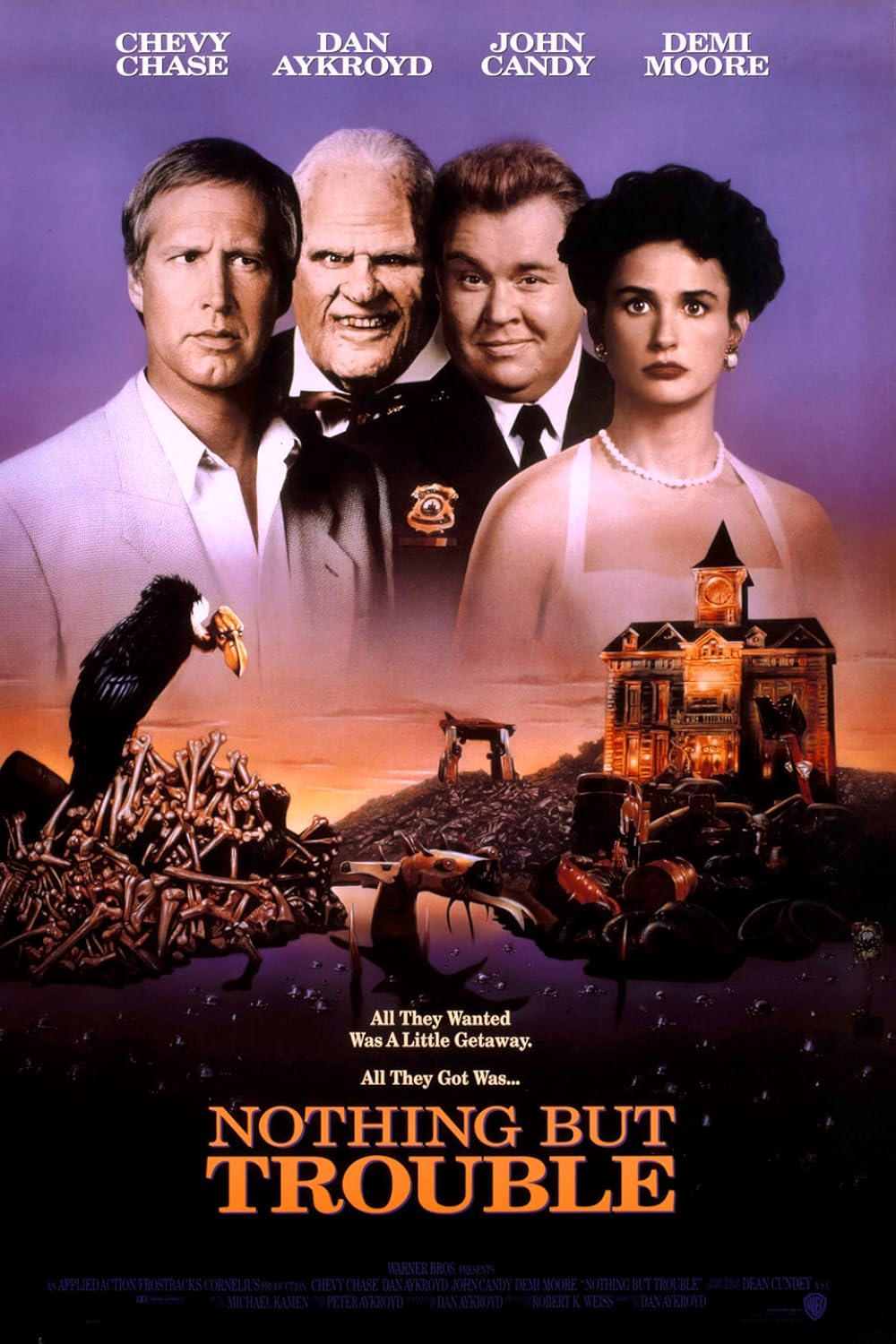
Released in 1991, Nothing but Trouble is one of those movies that makes you wonder how it ever got made, who thought it was a good idea, and why anyone involved believed audiences would respond normally to it. Written and directed by Dan Aykroyd, the film is a grotesque, bizarre, occasionally hilarious comedy that feels less like a conventional Hollywood production and more like somebody's fever dream after eating an entire refrigerator. It stars Aykroyd, Chevy Chase, Demi Moore, John Candy, and Digital Underground in a movie that somehow manages to be both a fascinating disaster and an unforgettable cinematic oddity.
The story begins when investment banker Chris Thorne, played by Chase, takes a wrong turn while driving through rural New Jersey with his girlfriend Diane, portrayed by Moore, and two wealthy Brazilian siblings. Their innocent detour leads them into the bizarre town of Valkenvania, where they are arrested for a minor traffic violation. Unfortunately, the local judge is an elderly, demented eccentric named Alvin Valkenheiser, played by Aykroyd, who has developed an elaborate system of punishments for anyone unlucky enough to enter his jurisdiction.
What follows is a series of increasingly grotesque encounters involving bizarre family members, enormous mechanical contraptions, disgusting meals, and a courthouse that looks like a haunted house designed by someone with absolutely no interest in restraint. John Candy plays two roles, including the judge's strange grandson Dennis, while Aykroyd transforms himself into a character who seems to have crawled out of a nightmare. The movie's visual style is deliberately excessive, with twisted architecture, grotesque prosthetics, and a general atmosphere of industrial decay.
The strangest thing about Nothing but Trouble is that it never seems particularly interested in being a normal comedy. Chase's familiar sarcastic persona is present, but the film repeatedly surrounds him with imagery so disturbing and ridiculous that his usual reactions barely register. Moore looks understandably bewildered, Candy disappears beneath layers of makeup, and Aykroyd appears determined to drag everyone into his peculiar vision of cinematic madness.
And then there's Digital Underground, the hip-hop group best known for introducing the world to Tupac Shakur on their 1991 single "Same Song." Their appearance is one of the film's most unexpected elements, culminating in a musical performance that feels completely disconnected from everything happening around it. Somehow, that only makes the movie more memorable.
Critics largely rejected Nothing but Trouble, and audiences weren't exactly lining up to celebrate it. The film became a notorious box-office disappointment, helping cement its reputation as one of the strangest major-studio comedies of its era. Yet its failure is also part of its peculiar charm. There is something admirable about a filmmaker receiving a substantial budget and using it to create something this unapologetically weird rather than delivering another predictable buddy comedy.
Today, Nothing but Trouble occupies an unusual place in the history of American comedy. It isn't a forgotten masterpiece, and its uneven pacing, crude humor, and excessive grotesquerie make it a difficult recommendation for casual viewers. But it is impossible to accuse the movie of being ordinary.
Hollywood has produced countless forgettable comedies over the decades. Nothing but Trouble is not one of them. It's a cinematic train wreck with a personality all its own, a monument to creative excess, and a reminder that sometimes the strangest movies are the ones that refuse to leave your brain long after the credits roll.
Review posted
October 25, 2026