
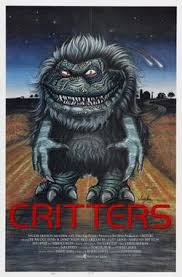
Released in 1986, Critters arrived during a golden age of small-budget horror comedies featuring nasty little creatures, inventive practical effects, and plenty of bloody mayhem. Riding the wave created by Gremlins, the film delivered its own version of extraterrestrial terror, replacing mischievous furry troublemakers with vicious, spiky balls of teeth that could turn an ordinary Kansas farmhouse into a battlefield. It wasn't trying to reinvent science fiction or redefine horror. It simply wanted to entertain audiences with miniature monsters, outrageous situations, and enough eighties attitude to fill a spaceship.
Directed by Stephen Herek, Critters begins with a group of dangerous alien fugitives escaping from an intergalactic prison. The creatures, known as Crites, eventually crash-land near a rural Kansas town, where they discover an abundance of food and a family unfortunate enough to be living nearby. The Brown family, led by hardworking father Jay, soon finds itself fighting for survival as the rapidly multiplying aliens begin devouring everything in sight.
The setup is simple, but the movie gets plenty of mileage out of it. The Crites are wonderfully nasty creations, covered in dark fur and equipped with enormous mouths filled with sharp teeth. Their ability to curl into spiked balls and roll toward their victims gives them a distinctive appearance, while their constant appetite provides the excuse for increasingly ridiculous attacks. Unlike some movie monsters that rely on atmosphere and mystery, these creatures are perfectly happy to make their presence known by chewing through anything unfortunate enough to cross their path.
The practical effects are a major part of the film's appeal. Long before computer-generated imagery became the default solution for cinematic creatures, filmmakers relied on puppetry, animatronics, makeup, and inventive camera work. The Crites have a tangible, physical quality that makes their antics convincing even when the action becomes deliberately absurd. They look like something that might have escaped from a particularly twisted toy factory, and their combination of menace and ridiculousness gives the movie its personality.
The cast also deserves credit for taking the material seriously enough to make the comedy work. Dee Wallace, already familiar to horror fans from E.T. the Extra-Terrestrial and The Howling, brings credibility to the role of Helen Brown. M. Emmet Walsh plays a local sheriff, while Billy Green Bush portrays Jay Brown. The film also features a young Billy Zane in one of his early screen appearances. Their performances give the story a grounded small-town atmosphere that contrasts nicely with the extraterrestrial chaos.
Then there are the bounty hunters, two alien shapeshifters sent to eliminate the Crites. Their arrival adds another layer of science-fiction absurdity, transforming the movie from a straightforward creature feature into something closer to a cosmic Western. Their unusual disguises and unconventional methods fit perfectly with the film's playful tone.
Critters became a modest success and spawned three sequels, establishing a lasting little corner of 1980s horror history. It never achieved the cultural dominance of Gremlins, but its fans appreciate its scrappy charm, practical effects, and uncomplicated approach to monster-movie entertainment.
Today, Critters remains a wonderfully entertaining slice of eighties genre filmmaking. It's messy, occasionally silly, and hardly sophisticated, but that's precisely the point. Sometimes audiences don't need complicated mythology or elaborate cinematic universes. Sometimes they just need a Kansas family, a couple of eccentric bounty hunters, and a pack of hungry alien furballs ready to eat the neighborhood.
Review posted
October 25, 2026