
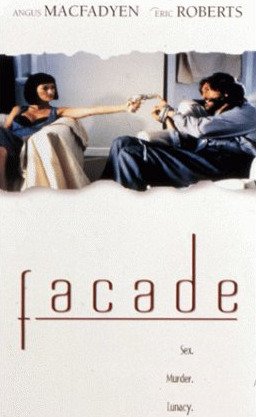
Some bad movies are boring. Some are confusing. Some are so spectacularly misguided that watching them becomes an entirely different kind of entertainment than the filmmakers intended. Facade, the 1999 thriller starring Eric Roberts, belongs firmly in that last category. It's the sort of movie that seems determined to convince you it's a sophisticated crime drama, even as practically everything on screen suggests a production that wandered into a much bigger story than it knew how to tell.
Directed by Carl Colpaert, Facade features Roberts as Colin Wentworth, with Angus Macfadyen, Camilla Overbye Roos, Joe Viterelli, and a supporting cast caught up in a story involving a wealthy Malibu widow, a contract on her life, a scorned lover, and a lunatic with grand ambitions for an enormous hotel. It sounds like the ingredients for a perfectly serviceable late-night thriller. In practice, it's closer to watching a bunch of people take turns behaving suspiciously while the movie desperately hopes nobody asks too many questions.
And that's where the fun begins.
A Thriller That Thinks It's Much Smarter Than It Is
The premise isn't inherently terrible. A wealthy widow becomes the target of a murder plot, shady characters circle around her, and the promise of money, revenge, and real estate provides plenty of potential for betrayal. There's room here for a stylish noir, a nasty little crime story, or a pulpy thriller packed with double-crosses.
Unfortunately, Facade seems to confuse having a complicated plot with having an interesting one.
The story piles on intrigue without consistently making that intrigue compelling. Characters have secrets, motivations, and suspicious connections, but the movie struggles to turn those ingredients into the kind of escalating tension that makes a thriller work. Instead of feeling like you're watching a clever criminal puzzle fall into place, you can find yourself wondering whether the characters understand what's happening any better than the audience does.
A good thriller lets you connect the dots while keeping you guessing about the final picture. A bad thriller throws the entire box of dots onto the floor, turns off the lights, and congratulates itself for creating a mystery.
Facade occasionally gives the impression that confusion is a substitute for suspense. It's not. Suspense requires investment in the characters and their predicament. Confusion merely requires patience, and this movie can test that patience in remarkably entertaining ways.
Eric Roberts: The Main Attraction
Eric Roberts is the obvious reason to give Facade a chance. By this point in his career, Roberts had established himself as a performer capable of bringing considerable intensity to crime dramas and thrillers. He has the screen presence to make even questionable material feel as though something important might be happening.
That's particularly useful in a movie like this, where the surrounding production doesn't always do him many favors.
Roberts brings a familiar seriousness to the proceedings. He looks like someone who has arrived to make a proper thriller, regardless of whether the screenplay has supplied him with a proper thriller to work with. There's something inherently amusing about watching a capable actor operate inside a film that seems to be fighting against its own ambitions.
He can deliver a line with the gravity of a man discussing a major criminal conspiracy, but the scene around him doesn't always generate the same level of urgency. The result is a curious disconnect between the performance and the material. Roberts appears to believe in the importance of the moment, while the movie seems unsure what the moment is supposed to accomplish.
That disconnect is a gift to anyone who enjoys gloriously misguided cinema.
Roberts isn't necessarily the problem. If anything, his presence gives the film a recognizable center. Without an actor who can command attention, the whole enterprise might drift into complete anonymity. Instead, he provides a reason to keep watching, even when the plot begins to resemble a collection of unrelated bad decisions.
The Supporting Cast and the Art of Looking Suspicious
The supporting cast includes Angus Macfadyen, Joe Viterelli, and several other performers who help populate the movie's world of money, manipulation, and murder. The basic casting ingredients are promising. There are actors here who can be effective in crime stories, and the premise offers plenty of opportunities for colorful character work.
Yet the film's dramatic machinery never consistently clicks into place.
In a stronger production, every supporting character would feel like a potential threat. A casual conversation might conceal a betrayal. A seemingly harmless exchange could become crucial later. Even a character sitting quietly in a room might make the audience wonder what they're planning.
In Facade, suspicion sometimes feels like the default setting rather than a carefully developed dramatic tool. People are shady because the plot needs them to be shady. Their behavior is supposed to make us curious, but the movie doesn't always provide enough substance to make that curiosity pay off.
The result can be unintentionally funny. You start watching everyone as though you're trying to identify the one person in a room who hasn't been informed that they're appearing in a thriller.
Naturally, the film wants the audience to take its criminal machinations seriously. That's part of the charm. The more earnestly it approaches its own complications, the more entertaining its shortcomings become.
The Hotel Plot Is Almost as Absurd as It Sounds
One of the film's central elements involves an ambitious scheme to construct an enormous hotel. In a more disciplined screenplay, that could be a useful expression of greed, vanity, or a character's desire to leave an oversized mark on the world.
Here, the idea contributes to the movie's peculiar collection of dramatic ingredients. A murder plot is already underway, personal grudges are involved, and now there's an ambitious construction project in the mix.
It's the kind of premise that makes you wonder whether the screenplay began as one movie and gradually absorbed pieces of three others.
The hotel scheme isn't inherently ridiculous. Crime stories have always found useful material in property deals, financial manipulation, and wealthy people behaving badly. The problem is that Facade doesn't always make these elements feel like parts of one coherent whole.
Instead, its various intrigues compete for attention. The movie has the raw material for a tangled story about greed and obsession, but the execution leaves too much of the connective tissue feeling flimsy.
It's difficult to make a criminal conspiracy feel genuinely impressive when the audience is spending so much time trying to figure out how all the pieces are supposed to fit together.
The Production Has That Wonderful Late-Night Movie Energy
There is a particular pleasure in watching a movie from this era that takes itself seriously while falling short of the slickness associated with bigger Hollywood thrillers. Facade has that late-night cable quality: the feeling that you've stumbled across something while flipping through channels and are now too fascinated by its oddities to change the station.
This isn't a film that needs to be judged against the technical polish of a major studio release. Low-budget filmmaking can produce terrific results, and plenty of great thrillers have been made without enormous resources.
But a limited budget makes clarity, pacing, atmosphere, and strong performances especially important. When the writing and storytelling aren't consistently sharp, the weaknesses become difficult to hide.
Facade doesn't always have the momentum to carry its elaborate plotting. Scenes can feel more interested in delivering information than generating excitement, and the dramatic developments don't always land with the force the filmmakers appear to intend.
The movie wants to be a sophisticated web of intrigue. The viewing experience can feel more like untangling a box of Christmas lights that someone stored incorrectly for twenty years.
You know there's a working arrangement somewhere in there. You just aren't convinced that finding it will be worth the effort.
Is It Actually Good-Bad Movie Material?
Absolutely, provided you approach it with the right expectations.
The best bad movies aren't necessarily the ones with the worst acting or the most ridiculous plots. They're the ones in which the gap between ambition and execution becomes part of the entertainment. The filmmakers are trying to accomplish something recognizable, but the finished product takes a detour into unintentional comedy.
Facade has that potential. Its murder conspiracy, wealthy characters, romantic grievances, and oversized ambitions create an atmosphere of relentless seriousness. Everyone appears to be operating in a world where the stakes are enormous. The trouble is that the movie doesn't always make those stakes feel enormous to the person watching.
That mismatch can be hilarious.
It's also the kind of film that benefits from a group viewing. Watch it with friends who appreciate questionable cinema, and the conversation afterward might be more entertaining than a discussion of a genuinely successful thriller. You'll have plenty to debate: which plot developments make sense, which characters are the most suspicious, and whether the film's many complications ever add up to the satisfying crime story it seems to promise.
Just don't expect a perfectly calibrated comedy. The humor comes from the movie's earnestness, not from a deliberate attempt to make the audience laugh.
Final Verdict
Facade is a fascinatingly imperfect thriller that promises murder, greed, betrayal, and wealthy people making terrible decisions, then struggles to transform those ingredients into a consistently compelling movie. Eric Roberts provides a recognizable focal point, and the premise offers enough intrigue to keep the film from being entirely forgettable. But the uneven storytelling and the gap between its ambitions and its execution make it difficult to recommend as a genuinely successful thriller.
As a piece of unintentional entertainment, however, it has considerably more going for it.
This is a movie to approach when you're in the mood for something strange, earnest, and just a little ridiculous. It wants to be taken seriously, and that seriousness is precisely what makes its shortcomings so amusing. The more elaborate the conspiracy becomes, the more you may find yourself admiring the sheer determination required to keep all these moving parts in motion.
The verdict: Facade isn't the hidden masterpiece its premise might suggest. It's a wonderfully questionable late-night thriller whose ambition occasionally outruns its execution. Eric Roberts gives you a reason to watch, the plot gives you plenty to question, and the overall experience offers the kind of entertainment that only a gloriously misguided movie can deliver.
Review posted
October 23, 2026