
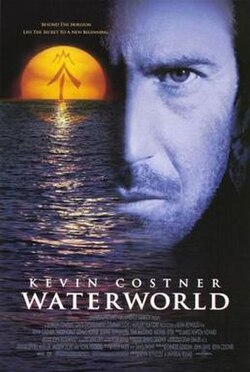
When Waterworld arrived in theaters in 1995, it was supposed to be one of Hollywood’s biggest action spectacles. Instead, it became one of the most notorious productions in movie history, surrounded by stories of ballooning budgets, disastrous filming conditions, and a production that seemed determined to sink before reaching shore. Nearly three decades later, however, Kevin Costner’s aquatic adventure deserves considerably more credit than its original reputation suggests. It might be an imperfect blockbuster, but it is also a fascinating piece of 1990s Hollywood excess.
Directed by Kevin Reynolds, Waterworld imagines a future in which melting polar ice caps have submerged nearly the entire planet. Humanity survives on floating settlements, makeshift boats, and isolated atolls, while fresh water and dry land have become precious commodities. Costner plays the Mariner, a mysterious drifter who has adapted to the ocean so thoroughly that he possesses gills and webbed feet. When he encounters Helen, played by Jeanne Tripplehorn, and her adopted daughter Enola, portrayed by Tina Majorino, he becomes entangled in their search for the mythical Dryland.
The premise is terrific. A post-apocalyptic world without roads, cities, or conventional borders offers endless possibilities for adventure. Instead of wandering through dusty wastelands, survivors navigate an enormous ocean, scavenging supplies and fighting over whatever resources remain. The film creates a distinctive visual identity through its floating communities, elaborate watercraft, and ramshackle settlements. Even today, the practical sets and ocean-based action give the movie a physical scale that many computer-generated blockbusters struggle to replicate.
Costner makes an interesting action hero precisely because the Mariner isn't particularly likable at first. He's selfish, antisocial, and perfectly comfortable abandoning people when they become inconvenient. His gradual transformation gives the story a recognizable emotional foundation beneath all the explosions and aquatic mayhem. Majorino also brings a natural charm to Enola, while Dennis Hopper steals scenes as the Deacon, the theatrical, tyrannical leader of the Smokers. Hopper plays the villain like a pirate who has wandered into a post-apocalyptic rock concert, and his gleefully unhinged performance supplies much of the film's entertainment value.
Of course, Waterworld has plenty of problems. Its enormous budget became a media obsession, and difficult ocean shoots contributed to production delays and escalating expenses. The resulting film occasionally feels as though its spectacular machinery is more interesting than its storytelling. Some sequences drag, the dialogue can be clunky, and the environmental allegory isn't exactly subtle. The Smokers' reliance on gasoline-powered machinery also makes them convenient villains in a movie concerned with environmental collapse.
Yet there's something wonderfully ambitious about the entire undertaking. In an era when Hollywood increasingly relies on familiar franchises and carefully managed cinematic universes, Waterworld represents a time when studios were willing to spend outrageous sums building an entirely new world, even if the experiment went spectacularly wrong.
Its commercial reputation also became more complicated over time. Although the production was expensive and the domestic box office disappointed expectations, international earnings and subsequent home-video releases helped soften the picture. Its reputation gradually evolved from embarrassing disaster to cult favorite.
Waterworld isn't a lost masterpiece, but it is a genuinely entertaining adventure with an imaginative setting, memorable performances, and an admirable commitment to practical spectacle. The movie that Hollywood once treated as a cautionary tale has become something more interesting: a reminder that a blockbuster can stumble, sink in public opinion, and still find its audience years later. Sometimes even the biggest Hollywood shipwreck deserves another look.
Review posted
October 25, 2026