
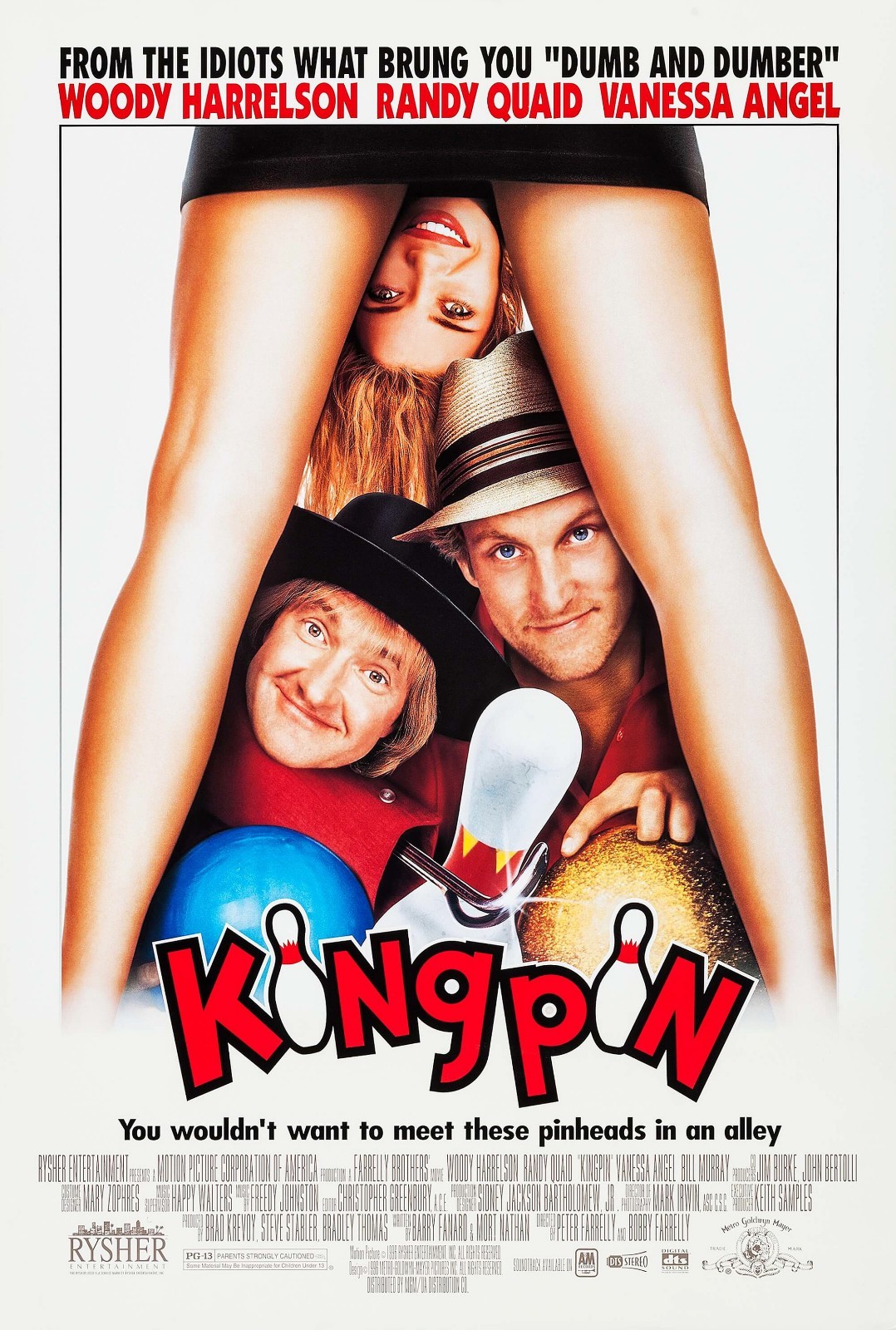
Released in 1996, Kingpin is one of the most outrageous sports comedies of the 1990s, a movie that takes the supposedly wholesome world of professional bowling and fills it with scammers, terrible haircuts, grotesque gags, and some of the most shamelessly inappropriate humor Hollywood could get away with. Directed by the Farrelly brothers, Peter and Bobby, the filmmakers behind Dumb and Dumber, the movie features Woody Harrelson, Randy Quaid, and Bill Murray in a comedy that is as ridiculous as it is surprisingly endearing.
Harrelson stars as Roy Munson, a former bowling prodigy whose promising career comes to a spectacularly humiliating end after he gets involved with a gang of crooked bowlers. Years later, Roy is a washed-up alcoholic living on the margins, nursing his bitterness and trying to scrape together enough money to survive. His fortunes change when he meets Ishmael, played by Quaid, an Amish man with an extraordinary natural talent for bowling. Recognizing an opportunity to make some money, Roy convinces Ishmael to leave his community and enter the professional bowling circuit.
The premise gives the Farrelly brothers plenty of opportunities to indulge their trademark combination of physical comedy, shocking gags, and uncomfortable situations. Roy is hardly a lovable mentor at first. He's selfish, manipulative, and frequently drunk, treating Ishmael as a potential payday rather than a person. Ishmael, meanwhile, approaches the outside world with a mixture of innocence and bewilderment that makes their partnership endlessly entertaining.
Harrelson is perfectly cast as Roy. He brings just enough charm to prevent the character from becoming completely repulsive, even when his behavior borders on the unforgivable. Quaid provides an excellent contrast, playing Ishmael with sincerity rather than turning him into a one-note joke. Their relationship gives the movie an unexpected emotional backbone, as Roy slowly discovers that helping someone else might be more rewarding than spending his life feeling sorry for himself.
Then there's Bill Murray as Ernie McCracken, the obnoxious bowling champion who ruined Roy's career. Murray's performance is magnificent. Ernie is arrogant, shameless, and utterly convinced of his own greatness, making him the perfect villain for a movie that delights in humiliating its characters. Murray seems to understand that the role requires maximum commitment and absolutely no dignity. Every appearance becomes an opportunity to steal the scene.
The bowling sequences are surprisingly effective, too. The sport provides a visual rhythm for the comedy, with dramatic tournament moments interrupted by absurd behavior and personal disasters. The film also captures the slightly seedy atmosphere of competitive bowling alleys, complete with tacky decor, questionable characters, and the unmistakable feeling that everyone involved has a complicated relationship with alcohol.
Of course, Kingpin isn't for everyone. The humor is crude, frequently offensive, and deliberately designed to push boundaries. Some jokes have aged better than others, and the film occasionally mistakes sheer outrageousness for sophistication. But its best moments demonstrate the Farrelly brothers' ability to combine gross-out comedy with genuine affection for their deeply flawed characters.
Although Kingpin received mixed reviews and modest box-office results upon release, it gradually developed a devoted following. Today, it stands as one of the most memorable comedies of its era, thanks largely to Murray's unforgettable performance and the chemistry between Harrelson and Quaid.
Kingpin proves that redemption doesn't always require a heroic speech or a dramatic transformation. Sometimes it involves a disgraced bowler, an Amish prodigy, and one spectacularly obnoxious champion getting exactly what he deserves.
Review posted
October 25, 2026