
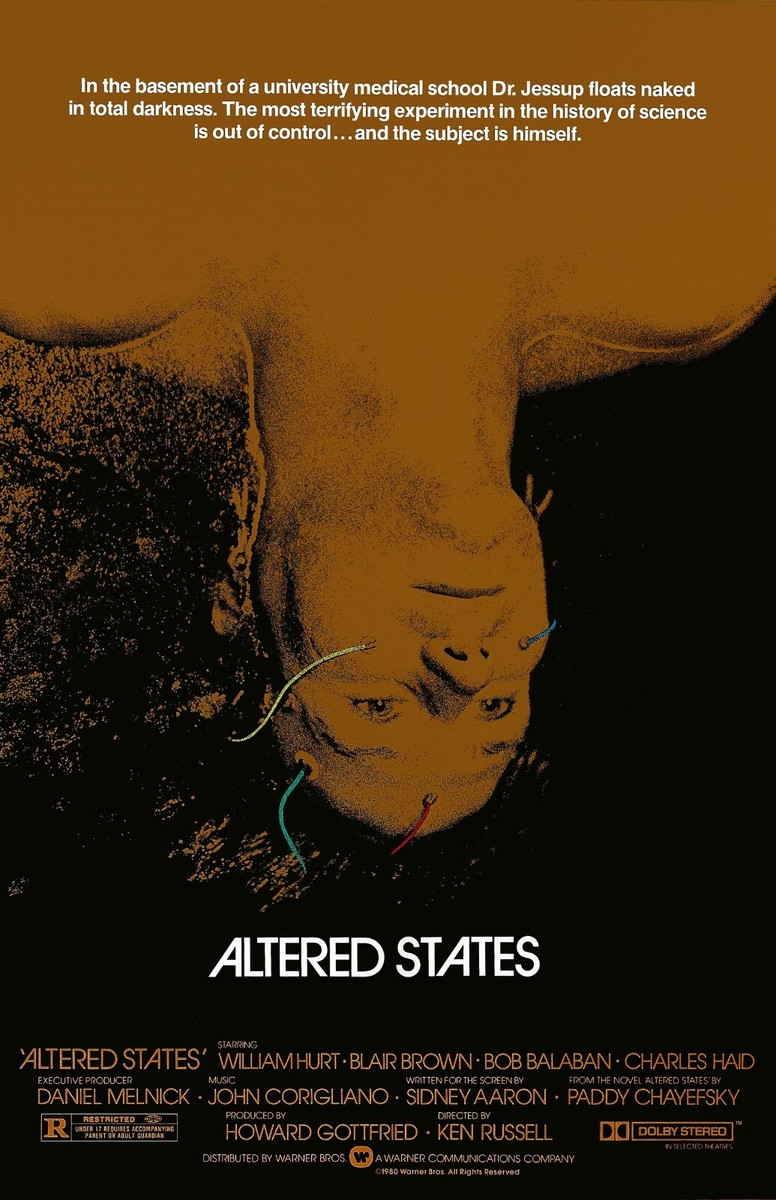
What happens when a brilliant scientist decides that the best way to understand human consciousness is to spend hours floating in a sensory deprivation tank while experimenting with powerful psychedelic drugs? Apparently, you become a walking evolutionary disaster, start hallucinating religious imagery, and eventually transform into something resembling a caveman who desperately needs a haircut. Welcome to Altered States (1980), a science-fiction horror movie that makes a convincing argument for occasionally just staying home and watching television instead of trying to unlock the secrets of the universe.
Directed by Ken Russell and based on the novel by Paddy Chayefsky, the film stars William Hurt as Eddie Jessup, a Harvard scientist who becomes obsessed with exploring the boundaries of human consciousness. His research involves sensory deprivation tanks, hallucinogenic substances, and increasingly questionable experiments that would probably have every university ethics committee reaching for the emergency telephone.
Eddie believes that altered states of consciousness might reveal something about humanity's earliest evolutionary origins. Naturally, rather than simply reading a book about evolution, he decides to become the experiment. What could possibly go wrong?
Initially, his experiments produce bizarre hallucinations and increasingly disturbing visions. But things take a turn when Eddie begins experiencing actual physical transformations. Apparently, his brain has decided that millions of years of evolution were a terrible idea, and he'd rather return to the prehistoric model. His colleagues are understandably concerned, although one wonders why nobody suggested that perhaps he should take a few days off.
William Hurt delivers an impressive performance as Eddie, portraying a man whose intelligence is matched only by his complete inability to recognize when he's gone too far. He's brilliant, obsessive, arrogant, and increasingly detached from reality. Blair Brown plays his wife, Emily, who spends much of the movie trying to maintain a marriage with a man who keeps disappearing into experimental bathtubs and returning as something that belongs in a natural history museum.
The special effects are easily among the film's biggest attractions. The psychedelic sequences are spectacularly strange, featuring distorted imagery, bizarre creatures, and visual sequences that look like someone fed a science textbook into a malfunctioning washing machine. The transformation scenes are particularly memorable, using practical effects to create some genuinely unsettling imagery.
Of course, the movie isn't exactly a relaxing experience. The philosophical discussions occasionally feel like listening to two professors arguing after drinking an entire chemistry laboratory, and the scientific explanations become increasingly difficult to follow. There are moments when you might wonder whether you're watching a science-fiction thriller or an extremely expensive college lecture about the human subconscious.
Still, Altered States deserves credit for being genuinely ambitious. It tackles consciousness, religion, evolution, identity, and the limits of human understanding without worrying too much about whether audiences will understand every minute of it.
Final Verdict: Altered States is a bizarre, ambitious, visually spectacular trip into the human mind that proves scientific curiosity can occasionally become a very expensive mistake. William Hurt is excellent, the effects are impressive, and the entire experience is gloriously strange. Just remember, if your research project involves psychedelic drugs and a sensory deprivation tank, maybe don't make it a family activity.
And perhaps leave evolution alone. It took millions of years to get us here, and Eddie Jessup apparently decided he could undo the whole thing over a long weekend.
Review posted
October 30, 2026