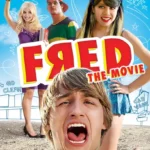
 Fred: The Movie is not good. Let’s get that out of the way immediately. It is loud, obnoxious, grating, visually ugly, narratively thin, and powered almost entirely by a pitch-shifted scream that feels like it was engineered in a lab to test human patience. And yet—somehow—it exists, it got sequels, it aired on Nickelodeon, and for an entire generation raised on early YouTube chaos, it is weirdly unforgettable. This is one of those movies where the phrase “awesome terrible” fits so perfectly it feels intentional.
Released in 2010, Fred: The Movie stars Lucas Cruikshank as Fred Figglehorn, a character born on YouTube in the Wild West era when viral fame required little more than a webcam, zero shame, and the willingness to yell into the void. Fred is a shrill, hyperactive, socially oblivious kid obsessed with his crush Judy and locked in a one-sided rivalry with neighborhood bully Kevin. The movie takes everything that worked (or at least went viral) in two-minute clips and stretches it to feature length—a decision that is both brave and catastrophic.
The plot, if you can call it that, revolves around Fred’s quest to win Judy’s affection while surviving Kevin’s relentless bullying. There are subplots involving Fred’s emotionally absent mother (played by Siobhan Fallon Hogan), a weirdly intense guidance counselor (John Cena, in one of the strangest casting choices of his career), and Fred’s over-the-top inner monologues that constantly break the fourth wall. Story logic is optional. Reality bends to Fred’s perception. If something can be louder, faster, or more annoying, the movie chooses that option every time.
What makes Fred: The Movie fascinating isn’t its quality—it’s the fact that it exists as a studio-backed artifact of early internet culture. This movie is essentially YouTube humor fossilized in HD. Jump cuts, exaggerated sound effects, random zoom-ins, and cartoon physics dominate every scene. Watching it now feels like opening a time capsule from 2007 and being immediately assaulted by auto-tuned chaos.
Lucas Cruikshank’s performance as Fred is relentless. There is no off switch. Fred screams, squeals, narrates, panics, and overreacts to everything. For some viewers, this is torture. For others—particularly those who grew up watching Fred videos—it’s strangely comforting. Cruikshank commits fully, and while the character is intentionally unbearable, that commitment is part of the appeal. This movie does not misunderstand Fred. It understands him perfectly and dares you to survive him for 90 minutes.
The supporting cast is baffling in the best way. John Cena plays Fred’s imaginary guidance counselor father figure, appearing shirtless, whispering motivational nonsense, and delivering advice with unsettling intensity. It’s one of those performances that feels like the actor lost a bet, then decided to go all-in anyway. Cena’s presence elevates the absurdity simply by existing within it.
Siobhan Fallon Hogan as Fred’s mom is another highlight, playing her character as aggressively irresponsible and emotionally vacant. She disappears for days, communicates through notes and phone calls, and seems utterly unfazed by Fred’s unhinged behavior. The movie treats this neglect as a joke, which is uncomfortable if you think about it for more than five seconds—but Fred: The Movie is not asking you to think. It is asking you to endure.
Visually, the movie looks like a migraine. Bright colors, constant motion, and editing that never breathes make it exhausting to watch. The soundtrack is packed with pop stings and sound effects that underline every single joke, as if the movie doesn’t trust you to realize something is supposed to be funny unless it screams it directly into your ears. Subtlety is not just ignored—it is actively hunted down and destroyed.
And yet, there is something oddly honest about it. Fred: The Movie is not pretending to be clever, ironic, or self-aware in a modern meta sense. It believes in its own stupidity. It treats Fred’s worldview as valid, centering his emotions and frustrations even when they’re ridiculous. In its own warped way, the movie is sincere about adolescent insecurity, loneliness, and the desire to be liked—just filtered through a megaphone.
The bullying subplot with Kevin is especially strange in hindsight. Kevin is portrayed as an almost supernaturally cruel antagonist, tormenting Fred with no motivation beyond pure menace. The movie exaggerates bullying to cartoon levels, which simultaneously trivializes it and makes it weirdly unsettling. Again, this is early YouTube logic: everything must be extreme, or it doesn’t register.
What ultimately makes Fred: The Movie an “awesome terrible” experience is its status as a cultural artifact. This is a movie that could only have been made at that exact moment, when viral fame was new, networks were desperate to monetize internet personalities, and the line between sketch, character, and brand was blurry at best. It’s a cautionary tale and a celebration rolled into one.
Watching it today is like revisiting a childhood embarrassment you’ve learned to laugh at. You don’t defend it. You don’t recommend it in good faith. But you recognize its place in pop culture history. It represents a time when being annoying online was enough to conquer the world—or at least Nickelodeon.
Is Fred: The Movie good? Absolutely not. Is it fascinating? Undeniably. Is it exhausting? Completely. But if you embrace it on its own terms—if you accept the noise, the chaos, and the complete lack of restraint—it becomes a strangely compelling train wreck. You can’t look away, even when you want to.
This is not a movie you watch for craftsmanship or storytelling. It’s a movie you watch to understand a moment in time, to witness the collision of internet fame and traditional media, and to marvel at how far sheer volume can carry a joke. Love it or hate it, Fred: The Movie is unforgettable—and sometimes, that’s enough.
click here to stream for free on Tubi
This post has already been read 491 times!


