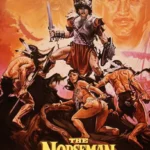
 The Norseman (1978) is one of those movies that feels less like it was made and more like it somehow washed ashore. It’s a film that exists in a fog of questionable decisions, half-remembered myths, and low-budget ambition so naked you almost have to admire it. Also released in some markets as The Viking Sagas, this is a sword-and-sandal movie filtered through late-1970s exploitation cinema, where historical accuracy is optional, acting is negotiable, and sheer earnestness is the strongest special effect.
This is an “awesome terrible” movie in the purest sense of the phrase. Not ironic. Not self-aware. Just a group of people trying very hard to make an epic Viking film with limited resources and an unlimited supply of confidence.
The plot is simple to the point of abstraction. A Norse prince’s father is murdered by a rival king, his mother is taken captive, and the young boy is set adrift at sea. Years later, he returns as a muscle-bound warrior to reclaim his birthright, rescue his mother, and restore honor to his people. If this sounds familiar, that’s because it’s basically Hamlet with axes, or Conan the Barbarian without the money, or any number of mythic revenge tales boiled down to their most primitive elements.
The title role is played by Lee Van Cleef… except it isn’t. That’s one of the movie’s most confusing quirks. In some international cuts and marketing materials, Van Cleef’s name is heavily emphasized, but he plays a supporting role as the villainous King Torvald. The actual Norseman hero is played by Steve Sandor, a Canadian bodybuilder whose physical presence does most of the storytelling. Dialogue is sparse, emotions are communicated through flexing, and subtlety is left frozen somewhere in the North Sea.
Sandor looks the part. He’s huge, stoic, and moves like someone who learned acting entirely through watching other people glare at horizons. When he’s not brooding silently, he’s swinging swords, throwing spears, or wrestling enemies into submission. It’s not a nuanced performance, but it doesn’t need to be. This is a movie where the lead character’s internal conflict is expressed entirely through shirtless revenge.
Lee Van Cleef, meanwhile, brings a strange sense of legitimacy to the proceedings. Fresh off his Spaghetti Western fame, he plays Torvald as a quiet, calculating villain, delivering his lines with the same measured menace he used in better films. Watching him interact with actors who seem to be in an entirely different movie is half the fun. Van Cleef looks like he wandered onto the wrong set and decided to commit anyway.
The production values are exactly what you’d expect from a late-1970s low-budget historical epic. The sets are minimal, the costumes look borrowed from a community theater Viking production, and the weapons appear dangerously close to foam. Locations do most of the heavy lifting, with forests, rocky coastlines, and open water standing in for epic landscapes. When the movie tries to feel grand, it mostly just feels cold.
The action scenes are clumsy but enthusiastic. Sword fights lack choreography and often devolve into awkward shoving matches, but there’s a rawness to them that almost feels authentic. People grunt, fall over, and die unceremoniously. There’s no polish, no slow-motion heroics, just blunt force and editing that cuts away before things get too complicated.
One of the movie’s most unintentionally hilarious aspects is its tone. The Norseman takes itself completely seriously at all times. There are no jokes, no winks to the audience, no acknowledgment that this is, in fact, a fairly ridiculous endeavor. This sincerity is what elevates it from boring to fascinating. The filmmakers genuinely believed they were crafting a mythic saga, and that belief carries the movie through its many shortcomings.
The pacing is uneven, drifting between long stretches of silence and sudden bursts of violence. Characters stare into the distance a lot. Conversations are brief and functional. Exposition is handled like an afterthought. At times, it feels less like a movie and more like a series of loosely connected Viking-themed tableaus.
The score is another highlight in a strange way. The music swells dramatically during moments that don’t quite earn it, lending everything an unearned sense of importance. It’s the kind of soundtrack that insists you’re watching something epic, even when the visuals suggest otherwise. That disconnect is part of the charm.
Thematically, The Norseman is obsessed with destiny, revenge, and masculine honor. Women exist mostly as symbols—mothers to be rescued, queens to be stolen, or silent witnesses to male suffering. This is very much a product of its time and genre, and the movie never challenges these conventions. It simply leans into them with unwavering conviction.
What makes The Norseman endure as an “awesome terrible” film is its purity. There’s no corporate cynicism here, no calculated nostalgia, no attempt to chase trends. It’s just a bunch of people trying to make a Viking epic because they thought it would be cool. And in its own awkward, lumbering way, it kind of is.
Modern viewers accustomed to sleek historical epics and prestige television Vikings will likely find this movie baffling. The fights are slow, the dialogue minimal, and the performances uneven. But if you approach it as a relic—a snapshot of exploitation cinema colliding with mythic ambition—it becomes a rewarding experience.
This is the kind of movie you put on late at night, half-watching, half-marveling at how it ever got made. It’s not good, but it’s sincere. It’s not exciting, but it’s weirdly hypnotic. And sometimes, that’s enough.
The Norseman doesn’t ask you to believe in its world so much as tolerate it. If you meet it halfway—accept the limitations, embrace the earnestness, and laugh when things get awkward—it becomes a strangely memorable journey through frozen landscapes and frozen performances.
It may not be the Viking epic it wanted to be, but as a time capsule of late-1970s genre filmmaking, it’s an oddly compelling watch. A flawed, lumbering, fur-clad artifact that stands as a testament to ambition outrunning resources.
click here to stream for free on Tubi
This post has already been read 560 times!


